
Every year on 19 August, the world observes World Humanitarian Day — a day to honour the people who step into war zones, disaster areas, disease outbreaks and humanitarian emergencies to protect lives and preserve human dignity.
But in 2026, remembering humanitarian workers is not enough.
The people who deliver food, medicine, shelter, clean water and protection to communities in crisis are increasingly facing the same dangers as the people they are trying to help. The United Nations’ 2026 World Humanitarian Day campaign therefore carries a much more urgent message: “The time for concern is over. The time for consequence is now.”
This raises an uncomfortable question:
What happens to humanity when the people trying to save lives are no longer safe themselves?
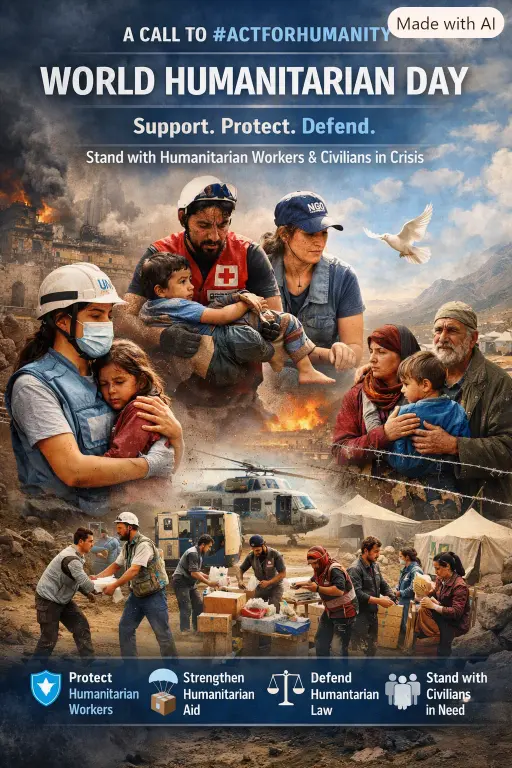
Why Is World Humanitarian Day Observed on 19 August?
The history of World Humanitarian Day is rooted in tragedy.
On 19 August 2003, a bombing at the Canal Hotel in Baghdad, Iraq, killed 22 humanitarian workers, including Sergio Vieira de Mello, the United Nations Special Representative for Iraq.
Five years later, the UN General Assembly designated 19 August as World Humanitarian Day through Resolution 63/139. The day was created to honour humanitarian workers and promote the protection, safety and dignity of people affected by crises.
What began as a day of remembrance has become a global call for action.
The Humanitarian Crisis Is Growing
Humanitarian emergencies are no longer isolated events that affect a small number of people for a short period.
Wars, displacement, extreme weather, food insecurity, disease outbreaks and economic instability can overlap, creating crises that last for years.
According to the UN’s 2026 figures, more than 252 million people were in urgent need of humanitarian assistance and protection by the end of May 2026.
Humanitarian organisations were planning to assist around 143.2 million people, while nearly 89 million people with the most severe needs were being prioritised for life-saving support.
Yet the resources available to respond to these needs remain far below what is required.
As of 31 May 2026, humanitarian plans required approximately US$33.66 billion, but only US$8.21 billion had been received — around 24.4% of the amount required.
This creates a dangerous gap:
More people need help, while the ability to provide that help is under pressure.
Humanitarian Workers Are Becoming Targets
One of the most disturbing developments is the increasing danger faced by aid workers themselves.
The UN reports that at least 326 humanitarian workers were killed across 21 countries in 2025, bringing the number killed over the three-year period to more than 1,000.
Recent reporting also highlights the continuing escalation of attacks against aid workers. Reuters reported that the Aid Worker Security Database recorded 907 humanitarian workers killed, injured or kidnapped in 2025, including 350 deaths.
These numbers represent much more than statistics.
Behind every number is a person.
A doctor who travelled into a dangerous area to treat patients.
A driver delivering food to displaced families.
A local volunteer helping children find shelter.
A logistics worker keeping an emergency operation running.
A nurse working in a damaged hospital.
When a humanitarian worker is attacked, the damage does not end with that individual. Entire communities can lose access to essential assistance.
Local Humanitarian Workers Carry a Huge Burden
Humanitarian work is often associated with international organisations, but many of the people providing assistance are local and national workers.
They are frequently helping communities where they themselves live.
That means they may face extraordinary risks while continuing to serve neighbours, relatives and communities affected by conflict or disaster.
The UN specifically highlights the need to recognise the risks faced by local humanitarian personnel and provide them with appropriate resources, training and protection.
This is an important reminder:
Humanitarian action is not only something delivered from outside. It is often led by people within the affected community.
Technology Is Changing Humanitarian Operations — and Warfare
Technology has transformed humanitarian response.
Digital communication allows organisations to coordinate relief operations across borders. Satellite imagery can help assess disaster damage. Data systems can identify communities requiring assistance. Drones can support mapping and assessment in difficult-to-reach areas.
Artificial intelligence may also help humanitarian organisations analyse information, predict needs and improve resource allocation.
But technology can also create new risks.
The UN’s 2026 World Humanitarian Day material points to emerging technologies, including armed drones and artificial intelligence, and stresses that technological change cannot remove human responsibility. International humanitarian law continues to apply regardless of the weapons or technologies involved.
This creates an important principle for the future:
Technology should strengthen humanitarian protection — not make humanitarian workers easier to target.
International Humanitarian Law Must Mean Something in Practice
Humanitarian workers and civilians are not supposed to be targets.
International humanitarian law establishes protections for civilians and humanitarian and medical personnel during armed conflicts. Parties to conflict are also required to allow and facilitate humanitarian relief for people in need, subject to the applicable rules of international humanitarian law.
The challenge is not simply creating rules.
The challenge is ensuring that those rules are respected.
When violations occur without accountability, international law risks becoming something that exists on paper but fails people when they need protection most.
That is why the UN’s 2026 campaign places emphasis on consequence and accountability, rather than concern alone.
The Human Cost of Conflict Goes Beyond the Battlefield
Humanitarian crises affect much more than immediate physical safety.
Children may lose access to education.
Families may lose their homes.
Healthcare systems can collapse.
Food supply chains can be disrupted.
People may be forced to leave their communities.
Businesses and local economies can disappear.
Mental and social well-being can suffer for years.
The UN reported more than 37,000 civilian deaths across 20 armed conflicts in 2025, while emphasising that this is a documented minimum and does not represent the full toll.
These figures show why humanitarian assistance cannot be treated simply as emergency charity.
It is part of protecting human dignity when normal systems have broken down.
What Can Individuals Do?
It is easy to feel powerless when looking at conflicts and humanitarian disasters happening thousands of kilometres away.
But humanitarian action does not belong exclusively to governments or international organisations.
Individuals can contribute by:
- Supporting credible humanitarian organisations.
- Donating responsibly to emergency relief efforts.
- Sharing verified information rather than misinformation.
- Supporting local community organisations.
- Volunteering when appropriate and safe.
- Learning about international humanitarian law and human rights.
- Speaking out against attacks on civilians and aid workers.
- Supporting initiatives that strengthen disaster preparedness and community resilience.
Even awareness has value when it leads to responsible action.
Businesses and Technology Companies Also Have a Role
Humanitarian response increasingly depends on infrastructure.
Communication networks allow emergency teams to coordinate.
Cloud platforms can support information systems.
Cybersecurity protects sensitive humanitarian data.
Satellite connectivity can connect isolated communities.
Data analytics can help organisations understand where resources are needed.
Artificial intelligence may help process large volumes of information during rapidly developing emergencies.
Technology companies therefore have an opportunity to contribute beyond conventional corporate social responsibility.
They can provide infrastructure, expertise, cybersecurity support, communications capabilities and responsible technology solutions that help humanitarian organisations operate more effectively.
But technology must always be guided by one principle:
Human life comes before technological capability.
From Sympathy to Action
World Humanitarian Day should not become another date on the calendar when we publish a message, add a hashtag and move on.
The purpose of the day is much deeper.
It asks us to remember the people who lost their lives while helping others.
It asks governments and parties to conflict to respect international humanitarian law.
It asks the international community to provide adequate funding for humanitarian operations.
And it asks ordinary people to recognise that behind every humanitarian crisis are individual human beings whose lives, families and futures matter.
The UN’s 2026 message is particularly direct: concern alone is not enough.
Protection requires action.
Accountability requires action.
Humanitarian funding requires action.
And protecting human dignity requires action.
Conclusion: Humanity Is a Choice
Wars may be decided by political leaders.
Disasters may be beyond our control.
But how we respond to suffering is a choice.
Humanitarian workers make that choice every day. They enter dangerous environments, work under extraordinary pressure and continue helping people when doing so can put their own lives at risk.
World Humanitarian Day gives the rest of us an opportunity to recognise that courage — but also to ask what we can do to make their work safer and more effective.
Because humanitarian workers should never have to choose between helping someone and protecting their own lives.
The people who save lives should not become targets.
And if we truly believe that every human life has value, World Humanitarian Day should not end with remembrance.
It should begin with action.
A Call to #ActForHumanity
This World Humanitarian Day, let us honour humanitarian workers not only with words, but by supporting their safety, strengthening humanitarian action, defending international humanitarian law and standing with civilians affected by conflict and disaster.
Because protecting those who help others is ultimately about protecting humanity itself.
Source: United Nations — World Humanitarian Day, 19 August. Read the official UN World Humanitarian Day page


