
Imagine walking through the dry grasslands of India and seeing a magnificent bird standing quietly against the horizon.
Tall. Powerful. Elegant.
For thousands of years, birds like this were part of India’s landscapes. They lived across vast stretches of grasslands and open country, moving through places where the land seemed endless.
Today, finding one is becoming extraordinarily difficult.
This is the Great Indian Bustard, scientifically known as Ardeotis nigriceps — one of India’s most remarkable birds and one of the rarest birds in the world.
It is classified as Critically Endangered, the highest risk category before extinction in the wild.
And its story is not simply about a bird.
It is about what happens when nature slowly loses its space.
It is about development without enough consideration for wildlife.
It is about disappearing grasslands, human activity, power infrastructure, hunting and other pressures.
Most importantly, it is about whether we will allow one of India’s most extraordinary birds to disappear from our skies.
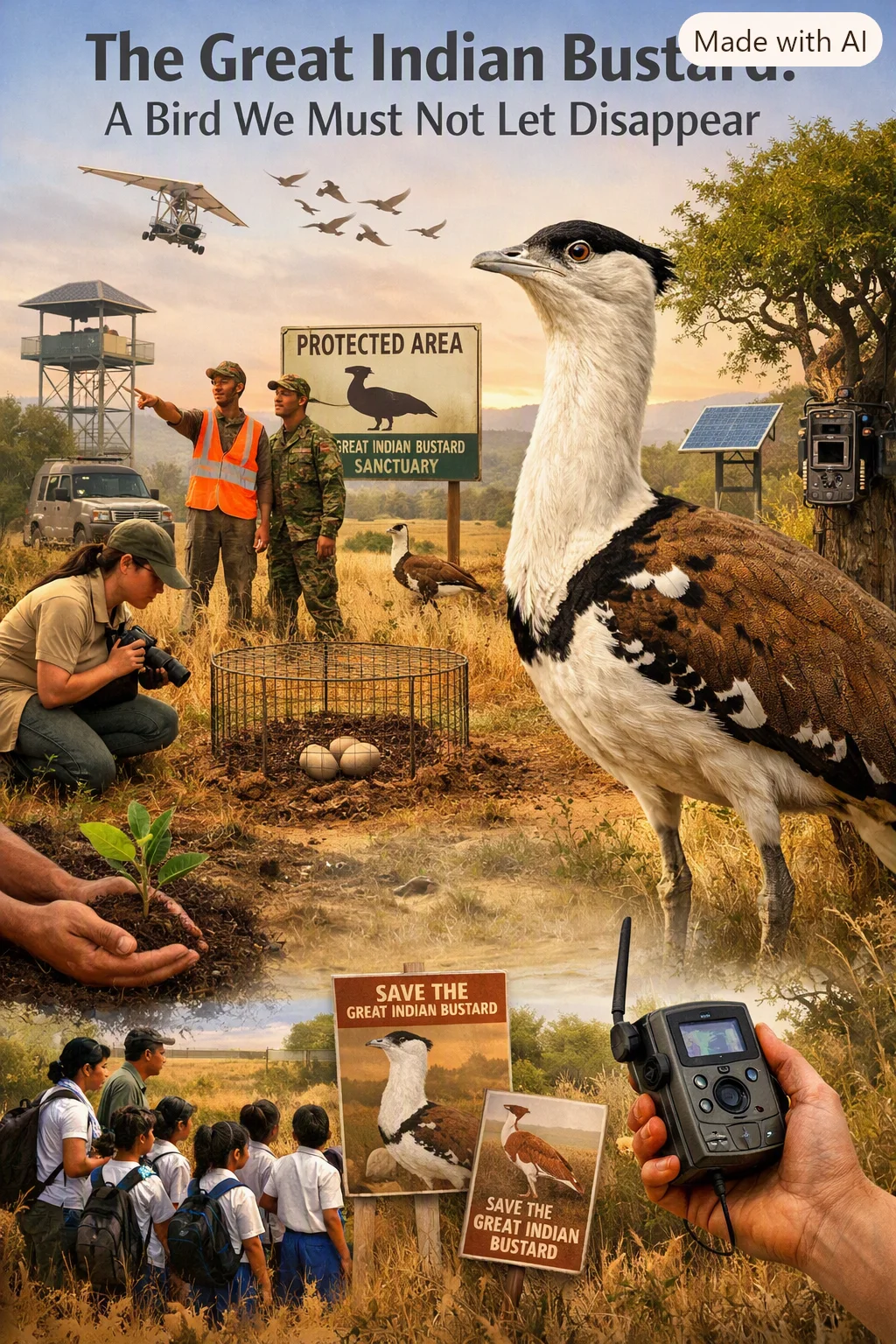
A Giant of India’s Grasslands
The Great Indian Bustard is an impressive ground-dwelling bird.
It can stand around a metre tall, with long legs, a strong body and a distinctive black crown contrasting with its pale head and neck. Males can weigh several kilograms, making the species one of the heaviest flying birds found in India.
But its size is not what makes it special.
Its importance comes from its place in India’s grassland ecosystems.
The Great Indian Bustard evolved to live in open landscapes — dry grasslands, semi-arid regions, open scrub and areas of rain-fed agriculture. These landscapes may look empty to us.
They are not empty.
They are home.
For the Great Indian Bustard, the grassland is not wasteland.
It is a nursery.
A feeding ground.
A breeding ground.
A shelter.
A home.
And when that landscape disappears, the bird has nowhere else to simply move to.
Once Widespread. Now Critically Endangered.
The Great Indian Bustard was once distributed across much larger areas of India and parts of Pakistan.
Historical records show that it once occurred across several Indian states, including Punjab, Haryana, Uttar Pradesh, Madhya Pradesh, Chhattisgarh, Odisha, Andhra Pradesh, Rajasthan, Gujarat, Maharashtra, Karnataka and Tamil Nadu.
Today, its remaining populations are restricted to isolated areas, particularly in states such as Rajasthan, Gujarat, Maharashtra, Karnataka and Andhra Pradesh.
The Wildlife Institute of India has described the Great Indian Bustard as one of the world’s rarest birds. Its conservation work has focused on habitat protection, research, population monitoring and conservation breeding.
Think about what that means.
A bird that once occupied enormous landscapes now survives in scattered pockets.
Every remaining bird matters.
Every breeding female matters.
Every chick matters.
Every safe grassland matters.
Why Is the Great Indian Bustard Disappearing?
There is no single reason.
Its decline is the result of several pressures acting together.
1. Loss of Grassland Habitat
One of the biggest problems is the loss and transformation of the bird’s natural habitat.
Grasslands are often misunderstood as empty or unproductive land. But these open ecosystems support an enormous variety of plants, insects, reptiles, mammals and birds.
When grasslands are converted for intensive agriculture, infrastructure or other land uses, the Great Indian Bustard loses the environment it depends upon.
The Wildlife Institute of India has identified habitat loss as one of the major factors behind the species’ decline.
A grassland may look ordinary to a passing person.
To a Great Indian Bustard, it may be the difference between survival and disappearance.
2. Power Lines: A Hidden Danger
One of the most serious modern threats is something that many of us barely notice.
Power lines.
The Great Indian Bustard is a large bird that flies relatively low and has difficulty detecting certain overhead power lines in its flight path.
Collisions can be fatal.
The Wildlife Institute of India and government conservation documents have identified power lines as a major threat and have recommended measures such as undergrounding lines in important habitats and installing bird diverters where appropriate to make lines more visible.
This creates a painful contradiction.
Electricity brings progress to communities.
But infrastructure placed through critical wildlife habitat can unintentionally create deadly obstacles for birds.
The answer is not to stop development.
The answer is to make development smarter.
Infrastructure and wildlife conservation must be planned together.
3. Hunting and Human Disturbance
Hunting historically played a significant role in the decline of the species.
Although the Great Indian Bustard is now legally protected in India, conservation remains difficult because the species has an extremely small population and a slow life history.
When a population becomes this small, every unnecessary loss becomes more serious.
There is a difference between losing one bird when thousands exist and losing one bird when only a very small population remains.
For an endangered species, an individual life can have enormous importance.
4. Predators, Roads, Agriculture and Other Pressures
The challenges do not end there.
Research has also identified increased predation pressure on nests and chicks, changes in agricultural practices, pesticide-related concerns, roads and other forms of infrastructure development as pressures affecting bustard habitats.
The problem is therefore bigger than protecting individual birds.
We must protect the landscape in which they live.
The Most Heartbreaking Part: They Reproduce Slowly
Nature has given the Great Indian Bustard a difficult challenge.
It is a species with slow life-history traits, which makes recovery from population declines especially difficult.
That means we cannot simply say:
“Let the population recover naturally.”
When a species has become critically rare, natural recovery can be extremely slow and vulnerable to even small additional losses.
This is why conservation breeding, habitat management, research and protection of breeding areas have become important parts of India’s conservation efforts.
India Is Fighting to Save It
There is still hope.
India has undertaken dedicated conservation efforts for the Great Indian Bustard.
The Ministry of Environment, Forest and Climate Change entrusted the Wildlife Institute of India with developing conservation plans for nationally important endangered species, including the Great Indian Bustard.
The Bustard Recovery Programme has included:
- Conservation breeding
- Habitat improvement
- Population monitoring
- Scientific research
- Protection of breeding areas
- Threat assessment
- Awareness and advocacy
- Capacity building
- Promotion of bustard-friendly land-use practices
The programme involves government agencies, state forest departments, research institutions and conservation partners.
In Rajasthan, for example, conservation efforts include population surveys, habitat protection, predator-proof enclosures and measures aimed at reducing power-line collision risks.
These efforts show something important:
Saving the Great Indian Bustard is possible — but it requires long-term commitment.
What Can an Ordinary Person Do?
You may be thinking:
“I am just one person. What difference can I make?”
More than you might think.
Conservation does not belong only to governments, scientists or wildlife organisations.
It belongs to all of us.
1. Don’t Harm Wildlife
Never hunt, trap, chase or intentionally disturb wild birds.
If you encounter wildlife, observe from a safe distance.
A photograph is not worth frightening an animal.
A video is not worth disturbing a nest.
A social-media post is not worth putting a bird at risk.
2. Don’t Buy Products Made From Wildlife
Never support illegal wildlife trade.
If there is no demand, there is less incentive to exploit wildlife.
Our choices as consumers can become part of conservation.
3. Respect Grasslands
Stop thinking of grasslands as “empty land.”
A landscape does not have to contain buildings, forests or farms to have value.
Sometimes the open land itself is the ecosystem.
Grasslands support birds, insects, reptiles, mammals and countless plants.
Protecting them means protecting an entire community of life.
4. Share Awareness
You don’t need to be a wildlife expert to make people aware.
Share reliable information.
Talk to your friends.
Teach children about India’s endangered species.
Post responsibly on social media.
Tell people why the Great Indian Bustard matters.
One person learning about a species can lead to another person caring about it.
And awareness can grow.
5. Support Genuine Conservation Organisations
If you choose to donate or volunteer, research the organisation carefully.
Support conservation programmes that work with recognised wildlife experts, government agencies, researchers or established conservation organisations.
You can also support awareness campaigns and responsible wildlife education.
6. Be a Responsible Wildlife Tourist
If you visit wildlife areas, follow local rules.
Don’t chase birds for photographs.
Don’t enter restricted areas.
Don’t play loud music.
Don’t litter.
Don’t approach nests.
Don’t feed wild animals.
And never sacrifice an animal’s safety for a better photograph.
Wildlife tourism should leave the animal’s life undisturbed.
Conservation Is Not Just About Birds
There is a larger lesson here.
When we protect the Great Indian Bustard, we are not protecting only one species.
We are protecting the grasslands.
We are protecting insects.
We are protecting native plants.
We are protecting other birds and animals that depend on the same ecosystem.
We are also protecting something that cannot be replaced once it is gone:
natural heritage.
A species that becomes extinct cannot simply be recreated.
We cannot bring back the last wild Great Indian Bustard after it disappears.
There is no replacement.
There is no backup.
There is only the choice to protect what remains.
Imagine a Future Without It
Imagine a child 50 years from now asking:
“What was the Great Indian Bustard?”
Imagine having to explain that it was once one of India’s greatest birds.
That it stood nearly a metre tall.
That it walked through India’s dry grasslands.
That it flew across open landscapes.
That people once saw it in places where it can no longer be found.
And then imagine telling that child:
“We knew it was disappearing. We knew it was rare. We knew the threats. But we didn’t do enough.”
That is the future we should never accept.
Give It a Future, Not Just a Memory
The Great Indian Bustard does not need our sympathy alone.
It needs space.
It needs safe habitat.
It needs protection.
It needs responsible development.
It needs scientific conservation.
It needs communities to be part of the solution.
And it needs people who care enough to speak about it.
The bird cannot explain what it needs.
It cannot write a letter.
It cannot ask us to protect its home.
So we have to speak for it.
The next time you see an image of the Great Indian Bustard, don’t just think about how beautiful or rare it is.
Think about the grassland beneath its feet.
Think about the sky above it.
Think about the dangers it faces.
And think about the possibility that one day, if we fail, there may be no Great Indian Bustard left to photograph.
Our Individual Promise
We don’t have to save the entire planet in one day.
We can start small.
Don’t harm wildlife.
Don’t support wildlife exploitation.
Respect natural habitats.
Keep a safe distance from wild animals.
Share awareness.
Support genuine conservation efforts.
Teach the next generation to respect nature.
And whenever we have a choice between convenience and unnecessary harm to wildlife, choose responsibility.
Because conservation is not only about saving animals.
It is about deciding what kind of world we want to leave behind.
Let the Great Indian Bustard Continue to Walk Our Grasslands
The Great Indian Bustard has survived for generations.
It has watched India’s landscapes change.
But now, its future depends heavily on what we do today.
A rare bird should not become a photograph in a textbook.
It should not become a name remembered from history.
It should continue to exist in the wild.
It should continue to walk across India’s grasslands.
Its chicks should continue to hatch.
Its wings should continue to rise into the sky.
And future generations should have the privilege of seeing this extraordinary bird alive — not just reading about it after it is gone.
The Great Indian Bustard is still here.
Let us make sure it stays.
Protect the habitat.
Respect the wildlife.
Spread the awareness.
Give the Great Indian Bustard a chance to survive.
Because once a species disappears, our regret cannot bring it back.


