
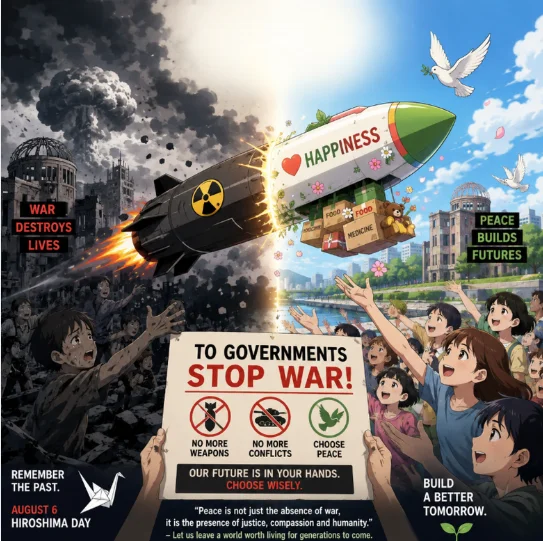
“No More Hiroshima. No More War.”
Every year on August 6, the world pauses to remember one of the darkest moments in human history. Hiroshima Day is not merely about recalling a historical event—it is a solemn reminder of the devastating consequences of nuclear warfare and a call for all nations to work toward lasting peace.
What Happened in Hiroshima?
On August 6, 1945, during the final stages of World War II, the United States dropped the world’s first wartime atomic bomb on the Japanese city of Hiroshima. Three days later, a second atomic bomb was dropped on Nagasaki.
The bomb released an enormous amount of energy in seconds. Entire neighborhoods were destroyed instantly. Tens of thousands of civilians—including children, doctors, teachers, and elderly people—lost their lives. Many others suffered severe burns, injuries, and radiation exposure that affected them for decades.
These bombings remain the only use of nuclear weapons in armed conflict.
The Human Cost of Nuclear Weapons
An atomic bomb is unlike conventional weapons. Its destruction extends far beyond the initial explosion.
The consequences include:
- Massive civilian casualties.
- Extreme heat capable of vaporizing buildings and people near the blast.
- Shockwaves that flatten entire cities.
- Radiation exposure causing long-term illnesses.
- Increased risks of cancer and genetic damage.
- Psychological trauma that can affect survivors for generations.
- Destruction of hospitals, schools, transportation, and essential infrastructure.
- Long-term environmental contamination.
- The effects continue long after the fighting ends.
Why Hiroshima Still Matters Today
More than 80 years later, the world still possesses thousands of nuclear weapons.
Modern nuclear arsenals are significantly more powerful than those used in 1945. Even a limited nuclear conflict could result in catastrophic humanitarian, environmental, and economic consequences affecting people far beyond the countries involved.
This is why Hiroshima serves as a warning—not only about history but about the future.
War Has No Real Winners
Throughout history, wars have changed borders and governments, but ordinary people pay the highest price.
- Children lose their families.
- Parents lose their children.
- Communities lose their homes.
- Generations lose opportunities to build better lives.
When cities become battlefields, it is civilians who suffer the most.
The Responsibility of Governments
Governments have the responsibility to protect human life.
Diplomacy, dialogue, international cooperation, and peaceful negotiation should always be pursued before military escalation. While nations have legitimate security concerns, the use of weapons capable of indiscriminate mass destruction carries profound humanitarian consequences.
The lessons of Hiroshima remind world leaders that decisions made during conflict can affect humanity for generations.
What Can Individuals Do?
Peace is not built only by governments—it also begins with ordinary people.
Every individual can contribute by:
- Promoting understanding instead of hatred.
- Respecting different cultures and communities.
- Rejecting violence as a first solution.
- Educating future generations about the consequences of war.
- Supporting humanitarian efforts that help victims of conflict.
Small actions collectively shape a more peaceful world.
Remembering the Victims
Hiroshima Day is about honoring the lives that were lost and standing with those who survived unimaginable suffering.
Their stories remind us that behind every statistic is a human being with dreams, hopes, and loved ones.
History should not be forgotten—it should be learned from.
A Message for the Future
Humanity has achieved incredible scientific and technological progress. Those advancements should improve lives, cure diseases, educate children, and protect our planet—not destroy cities.
The memory of Hiroshima should inspire every nation to pursue peace, reduce the risk of nuclear conflict, and resolve disputes through dialogue rather than devastation.
No More Hiroshima. No More War.
Let history be remembered—not repeated.


