
Introduction: When Conflict Becomes Everyone’s Problem
War is often described through the actions of governments, armies, weapons and borders. But the real cost of war is paid by communities.
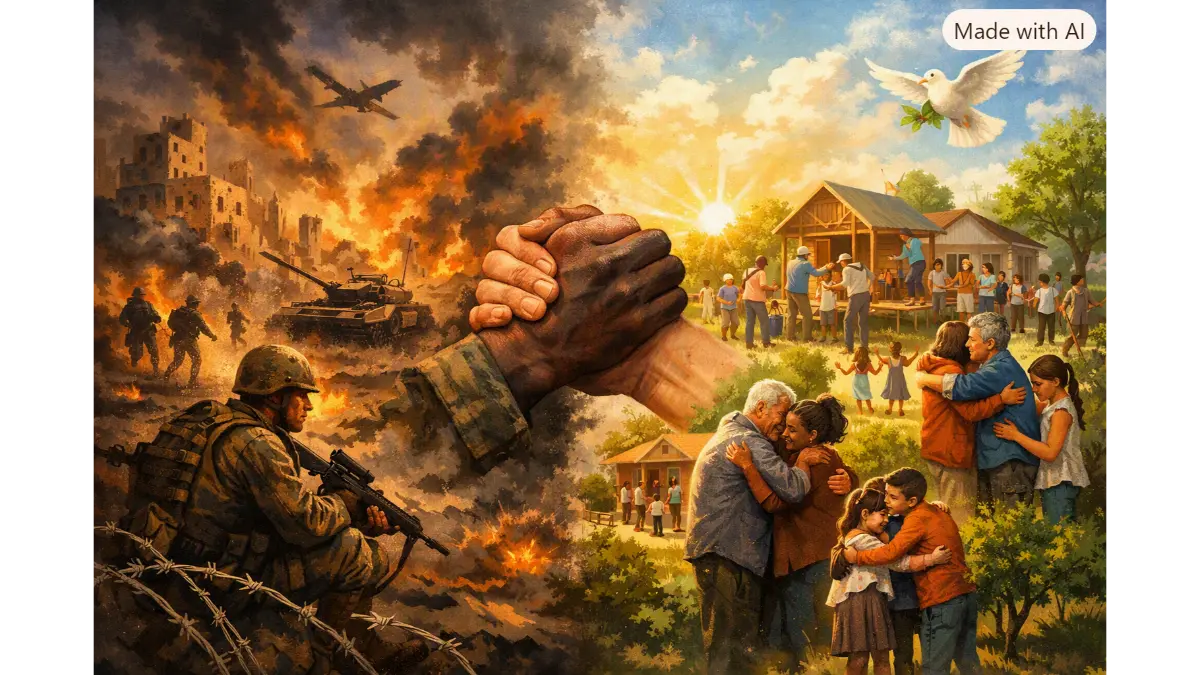
A war can destroy homes, separate families, close schools, collapse healthcare systems, displace entire populations and leave psychological and economic scars that continue for generations. Civilians have historically been among the principal victims of armed conflict, which is why international humanitarian law places strong emphasis on their protection.
The important question, therefore, is not simply how wars are won.
It is:
How can societies prevent conflicts from becoming wars, and how can human life be protected when violence has already begun?
Research from the United Nations, World Bank, UNDP and International Committee of the Red Cross suggests that prevention is possible. It requires more than diplomacy at the final stage of a crisis. It requires communities, governments and international institutions to identify risks early, address grievances, protect vulnerable populations and create peaceful alternatives to violence.
1. War Usually Begins Before the First Shot
A war rarely appears overnight.
Before large-scale violence begins, societies may experience years of political exclusion, inequality, discrimination, competition over resources, institutional weakness, economic insecurity, misinformation, social divisions or unresolved historical grievances.
The 2018 UN–World Bank study Pathways for Peace: Inclusive Approaches to Preventing Violent Conflict argues that prevention should begin by addressing these underlying drivers rather than waiting until violence has already escalated. The study emphasizes inclusion, institutions and early preventive action as important components of reducing the risk of violent conflict.
This changes the way we should think about peace.
Peace is not simply the absence of shooting.
Peace is the presence of systems that give people alternatives to violence.
2. Case Study: Kenya and the Power of Prevention
Kenya provides an important example of why prevention needs to happen before violence becomes uncontrollable.
The country’s experience demonstrates the importance of identifying political and social risks early and developing mechanisms that can respond before tensions escalate.
UNDP’s 2026 Evidence for Prevention study examines Kenya alongside Mauritania and Norway as examples of nationally led prevention strategies. The study does not present one universal formula for peace, but identifies transferable principles including political inclusion, trusted institutions, socioeconomic opportunities and anticipatory governance.
The lesson is significant.
A government does not have to wait for communities to become violent before responding to their grievances.
It can establish:
- early-warning mechanisms;
- community dialogue;
- inclusive political institutions;
- mediation systems;
- youth employment opportunities;
- stronger local governance;
- trusted channels for reporting tensions; and
- rapid responses to emerging crises.
The earlier these systems operate, the greater the opportunity to prevent violence.
3. Case Study: Colombia — From Conflict to Community Participation
Colombia demonstrates another important principle: peace cannot depend exclusively on governments and military institutions.
Civil society can play a critical role.
UNDP research into conflict-prevention partnerships examined Colombia and other countries, focusing on how civil-society organizations can contribute to prevention and post-conflict peacebuilding. The Colombia case highlighted mechanisms for strengthening civil society organizations and supporting local initiatives.
This matters because communities often understand local tensions before national institutions do.
A local teacher may recognize increasing hostility between groups.
A community leader may know that a dispute over land is becoming dangerous.
A religious or cultural organization may have relationships with groups that no longer trust government officials.
A youth organization may understand how unemployment and hopelessness are influencing young people.
These community-level relationships can become part of an early-warning and early-response system.
4. The Economic Argument for Peace
Preventing war is not only a humanitarian responsibility.
It also makes economic sense.
The UN–World Bank Pathways for Peace study estimated that a scaled-up system of preventive action could save between US$5 billion and US$70 billion every year, depending on the scenario. The study argues that preventing violent conflict is considerably less costly than responding after violence has escalated.
War destroys economic infrastructure while simultaneously increasing the cost of humanitarian assistance, security, reconstruction and displacement.
Consider what happens when violence reaches a city:
A hospital may stop functioning.
Businesses close.
Workers lose income.
Children stop attending school.
Roads and electricity networks may be damaged.
Families flee.
Governments redirect money from development toward emergency response.
Neighbouring countries may have to absorb refugees.
The economic consequences therefore extend far beyond the battlefield.
Prevention is an investment, not simply an expense.
5. Protecting People When Prevention Fails
Unfortunately, prevention cannot eliminate every war.
When armed conflict begins, the second responsibility is to reduce human suffering.
This is where international humanitarian law becomes essential.
The Geneva Conventions and related rules establish protections for people who are not, or are no longer, participating in hostilities. These include civilians, wounded people and captured combatants.
International humanitarian law also establishes important principles governing military operations, including:
Distinction
Military forces must distinguish between military objectives and civilians.
Proportionality
Military operations must consider the expected harm to civilians in relation to the anticipated military advantage.
Precautions
Parties to a conflict must take feasible precautions to reduce civilian harm.
Protection of medical services
Medical personnel, facilities and transports receive special protection under international humanitarian law.
These rules do not make war safe.
But they create a legal and humanitarian boundary around what can be done during war.
6. The Community Is Often the First Humanitarian System
During a major conflict, international organizations may arrive with food, medicine, shelter and logistical support.
But communities are usually already there.
Neighbours help neighbours.
Teachers protect children.
Doctors continue working under dangerous conditions.
Local volunteers distribute food.
Families provide shelter to displaced people.
Community organizations identify vulnerable individuals.
This means humanitarian planning should not treat communities merely as victims.
Communities can be part of the solution.
A resilient community can establish emergency communication systems, evacuation plans, local medical networks, shelters, volunteer groups and trusted information channels before a crisis occurs.
Preparedness can therefore save lives even when diplomacy fails.
7. Information Can Save Lives — and Misinformation Can Destroy Them
Modern conflict is no longer fought only on physical battlefields.
Information can influence how populations perceive one another.
False information can create fear.
Propaganda can dehumanize entire communities.
Rumours can trigger violence.
Manipulated images can create outrage.
Social media can rapidly amplify unverified claims.
This makes information literacy an important part of community resilience.
A society that can distinguish verified information from deliberately manipulated content is better positioned to resist panic and escalation.
Governments, technology companies, journalists, schools and civil-society organizations therefore have a shared responsibility to strengthen reliable information systems while protecting legitimate freedom of expression.
8. Youth: The Most Important Long-Term Investment
Young people are often discussed as a vulnerable population during conflict.
But they are also one of the most important groups for preventing future conflict.
A young person who has access to education, employment, political participation and a meaningful future has alternatives to violence.
The UN–World Bank research emphasizes the importance of addressing exclusion and unmet aspirations and specifically highlights participation by women and youth in decision-making as important to sustaining peace.
This leads to a simple but powerful principle:
Peacebuilding should begin long before young people are asked to pick up weapons.
Education, employment, entrepreneurship, sports, cultural programs, civic participation and digital literacy can all contribute to stronger communities.
9. Women and Local Leadership Matter
Peace negotiations are often presented as conversations between political and military leaders.
But sustainable peace requires broader participation.
Women, community leaders, civil-society organizations, local governments, educators and young people can provide perspectives that may be missing from high-level negotiations.
The objective should not simply be to stop fighting.
It should be to build a political and social system in which people have peaceful mechanisms for resolving future disagreements.
Otherwise, a ceasefire can become only a pause between conflicts.
10. What Governments Can Do Before Violence Escalates
A practical conflict-prevention strategy can include five layers.
1. Detect
Monitor social, economic and political indicators that could signal rising tensions.
2. Listen
Create trusted channels through which communities can report grievances.
3. Mediate
Bring conflicting groups together before disputes become violent.
4. Include
Ensure minorities, women, youth and marginalized communities have meaningful participation.
5. Respond
Act quickly when early-warning systems identify serious risks.
UNDP’s recent research similarly emphasizes anticipatory governance, trusted institutions, political inclusion and socioeconomic opportunity as components of effective national prevention strategies.
11. What International Organizations Can Do
International organizations cannot simply arrive after a war begins.
They can support prevention through:
- diplomatic mediation;
- early-warning systems;
- humanitarian preparedness;
- peacebuilding programs;
- support for local institutions;
- economic development;
- election and governance assistance;
- protection of civilians;
- humanitarian corridors where applicable;
- support for displaced populations;
- monitoring and documentation of violations.
The humanitarian-development-peace approach is increasingly being used to connect immediate humanitarian needs with longer-term development and peacebuilding. UNDP’s 2026 case-study series examining Iraq, Ukraine and Yemen illustrates efforts to improve coordination between these areas.
12. What Ordinary People Can Do
It is easy to believe that preventing war is only the responsibility of presidents, diplomats and armies.
It isn’t.
Communities can contribute to peace in practical ways.
People can:
Question before believing.
Do not spread unverified claims about another community.
Talk before judging.
Direct dialogue can prevent stereotypes from becoming hatred.
Protect vulnerable people.
During crises, children, older people, people with disabilities and displaced families often face disproportionate risks.
Support credible humanitarian organizations.
Food, medical assistance and shelter can save lives.
Reject dehumanization.
Calling an entire population evil makes violence easier to justify.
Teach the next generation.
Children should learn that disagreement does not require hatred and that political differences can be resolved peacefully.
13. A Practical Model for Saving Lives
A useful framework can be summarized as:
PREVENT → PREPARE → PROTECT → RECOVER → RECONCILE
PREVENT
Identify grievances and risks before violence begins.
PREPARE
Build community emergency systems, humanitarian networks and reliable communication.
PROTECT
When conflict occurs, enforce international humanitarian law and prioritize civilian safety.
RECOVER
Restore healthcare, education, housing, infrastructure and livelihoods.
RECONCILE
Address grievances, rebuild trust and create institutions capable of preventing future violence.
This is not a guarantee that war will disappear.
It is a framework for reducing the probability, scale and human cost of conflict.
14. The Bigger Lesson
History shows that humanity has repeatedly developed institutions after experiencing catastrophic suffering.
The Geneva Conventions emerged from the recognition that even during war, humanity needs rules.
Modern conflict-prevention research goes one step further.
It asks:
Why wait for people to suffer before we act?
The evidence increasingly supports a shift from reaction to prevention. The World Bank and UN have argued that prevention can save lives while also avoiding enormous economic costs. UNDP’s recent research reinforces the importance of addressing structural risks before they become crises.
The challenge is that prevention is often invisible.
When a war does not happen, there are no dramatic photographs showing what was avoided.
There is no headline saying:
“Thousands of people lived normal lives today because a conflict was prevented.”
But that is precisely what successful prevention looks like.
Conclusion: The Greatest Victory Is the War That Never Happens
War should not be measured only by territory gained or battles won.
A better measure of success is the number of lives protected.
A child who continues going to school is a success.
A family that does not have to flee its home is a success.
A community that resolves a political dispute without violence is a success.
A government that responds to grievances before they become rebellion is a success.
A humanitarian corridor that allows civilians to escape danger is a success.
And a diplomatic agreement that prevents thousands of people from becoming victims is perhaps one of the greatest victories humanity can achieve.
We cannot eliminate every disagreement.
We cannot guarantee that every conflict will be resolved peacefully.
But we can build societies where disagreement does not automatically become hatred, where grievances have peaceful channels, where communities are prepared for crises, where international law protects civilians, and where leaders understand that prevention is cheaper and more humane than destruction.
The goal should not simply be to win wars.
The goal should be to make fewer wars necessary, fewer civilians vulnerable, and fewer lives lost.
Because the most meaningful victory is not defeating another human being.
It is preventing human beings from having to become enemies in the first place.
Research Sources
- United Nations Development Programme — Evidence for Prevention (2026), examining nationally led prevention strategies and lessons from multiple country cases.
- World Bank & United Nations — Pathways for Peace: Inclusive Approaches to Preventing Violent Conflict, a major study on conflict prevention and inclusive approaches.
- International Committee of the Red Cross — International humanitarian law and the protection of civilians during armed conflict.
- UNDP — Research on civil-society partnerships and conflict prevention, including case studies from Colombia and other countries.
- UNDP — 2026 case studies on the Humanitarian-Development-Peace Nexus in Iraq, Ukraine and Yemen.


