
Let Elephants Live: A Call for Compassion, Coexistence and Nature
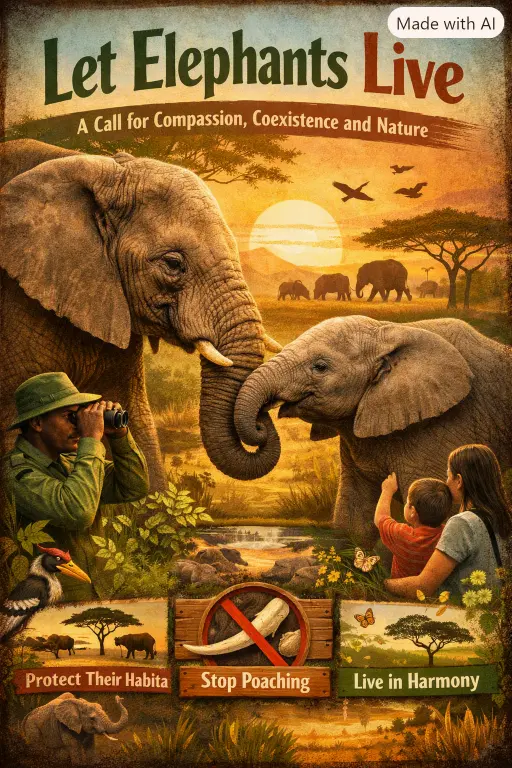
There was a time when elephants walked freely through forests, following the same ancient paths their ancestors had walked for generations. They moved with patience, strength and a quiet dignity that has existed long before our cities, roads and buildings.
Today, many of those paths are disappearing.
Forests are being cleared. Roads are cutting through habitats. Human settlements are expanding deeper into wildlife territories. And somewhere in between all of this, elephants are simply trying to survive.
We often call ourselves the most intelligent species on Earth. We build cities, invent technology and explore space. But perhaps true intelligence is not only about what we can create. It is also about understanding what we must protect.
Elephants Are Not Our Enemies
When an elephant enters a village or damages a crop, it is easy to see the animal as a problem.
But we should ask ourselves a different question:
Why did the elephant come there in the first place?
Perhaps the forest it once depended on is no longer large enough. Perhaps its traditional migration route has been blocked. Perhaps food and water have become difficult to find.
The elephant does not understand property boundaries, highways or human maps.
It only knows where it has always travelled.
What we sometimes call a “human-wildlife conflict” is often a conflict created by the shrinking space between human life and wild nature.
They Feel. They Remember. They Belong.
Elephants are remarkable animals. They form strong family bonds, care for their young and show behaviours that demonstrate social connection and memory.
A young elephant learns from its family.
It learns where to find water.
It learns which paths are safe.
It learns how to survive.
When an elephant loses a family member, the loss is not meaningless. These are social, intelligent beings living complex lives of their own.
We do not need to make animals exactly like humans to understand that they deserve compassion.
We simply need to recognize that their lives have value even when they provide us with nothing.
Nature Does Not Belong Only to Us
We often speak about protecting forests as though we are doing nature a favour.
But forests protect us too.
They provide water, regulate climate, support biodiversity and maintain the delicate systems that make life possible.
Elephants themselves play an important role in forest ecosystems. As they move through landscapes, feed on vegetation and disperse seeds, they can help shape and regenerate the forests they inhabit.
When we protect elephants, we are not protecting just one species.
We are protecting an entire ecosystem.
We Must Learn to Coexist
Saving elephants does not mean ignoring the needs of people living near forests.
Farmers deserve protection. Communities deserve safety. Families deserve secure livelihoods.
The answer is not to choose humans over animals or animals over humans.
The answer is to find ways for both to exist.
Better wildlife corridors, responsible land planning, early-warning systems, community participation, protection of forests and stronger conservation efforts can help reduce conflict.
Most importantly, we need compassion on both sides.
Every Generation Has a Choice
One day, children may ask us what elephants were like.
Will we show them photographs and videos and say:
“They once lived here.”
Or will we take them to forests where elephants still walk freely and tell them:
“We protected them. We made space for them. We understood that this planet was never ours alone.”
That choice is being made today.
Every forest we protect matters.
Every illegal act against wildlife we prevent matters.
Every person who chooses compassion matters.
Every voice raised for nature matters.
Let Them Walk
Elephants do not need our pity.
They need space.
They need forests.
They need safe migration routes.
They need clean water.
They need protection.
And above all, they need us to understand one simple truth:
We are not separate from nature. We are a part of it.
The Earth does not belong only to humans.
It belongs to the elephant walking through the forest, the bird resting on a branch, the deer searching for water, the tiger moving silently through the grass, and every living creature that shares this beautiful planet with us.
If we truly call ourselves civilized, let our civilization be measured not only by the buildings we construct, but by the lives we choose to protect.
Save the forests. Protect wildlife. Respect every living creature. Give elephants a future.
Because when the last elephant disappears from a forest, we don’t just lose an animal.
We lose a part of the Earth that can never be replaced.


